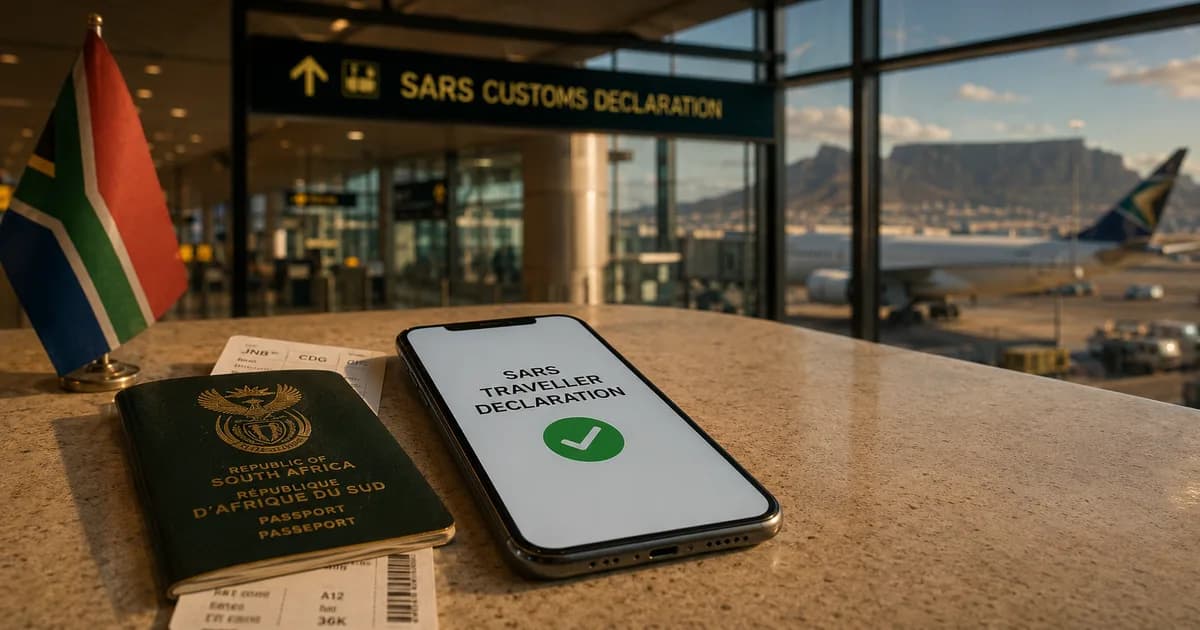
In brief (TL;DR): From 1 July 2026 every traveller entering or leaving South Africa must submit an online SARS declaration before they travel. It is a customs and border step, submitted no more than 24 hours before departure, and it is completely separate from the electronic allowances (the R2 million SDA and R10 million FIA) that govern how you actually move money across the border.
The South African Revenue Service has made its online traveller declaration compulsory from 1 July 2026 for anyone crossing a South African border. If you fly home to see family, return to South Africa for good, or head back to the UK after a visit, this now applies to you. It is a customs and border process, and understanding what it does and does not cover matters, particularly if part of your trip involves your money.
Complete your declaration: the direct links
Bookmark these before you fly. This is the customs step, done on SARS's own system, and it takes a few minutes.
What the new SARS traveller declaration actually is
The SARS traveller declaration is an online form that every person entering or leaving South Africa must now submit before they travel. It replaces the old paper process and runs through the South African Traveller Management System, known as SATMS. The system had been piloted on a voluntary basis at selected airports since 2022 before being extended to land and sea ports. From 1 July 2026 it is mandatory nationwide, given legal effect by amendments to the Customs and Excise Act of 1964.
The requirement is broad. It covers South African citizens, permanent residents and foreign visitors, and it applies whether you travel by air, road, sea or rail. A parent, legal guardian or another assisting person completes the declaration on behalf of a child or anyone unable to do it themselves. The one general exemption is for air or sea passengers who are only transiting through South Africa and do not leave the designated transit area.
When and how to submit your declaration
You must submit your declaration no more than 24 hours before departure from the country you are travelling from. If you are flying to South Africa on a journey with stopovers, you complete it within 24 hours of the final leg directly into the country. There are several ways to do it: the SARS website Traveller Management System, the SATMS app from your phone's app store, a QR-code scan on any internet-connected device, or a self-service kiosk at ports where one is installed.
You will generally need your passport or travel document details, your travel details, your contact details, and the details of anyone travelling with you. You then indicate whether you are carrying goods, currency or bearer negotiable instruments that need to be declared. Once submitted, SARS emails you a confirmation with instructions for when you arrive. Keep that confirmation on your phone or print it, and follow the signage at the port.
What happens if you do not declare before you travel
You will not be denied entry to or exit from South Africa solely because you did not complete a declaration in advance. This is the point the alarmist social media posts get wrong. SARS has been explicit that Customs officials, backed by self-service terminals at ports, will help travellers who were unable to submit beforehand. The sensible advice is still to declare in advance, because it speeds up your crossing, but a missed pre-declaration is not an automatic penalty.
The real enforcement risk lies elsewhere. It attaches to failing to declare dutiable, prohibited or restricted goods, or currency above the relevant threshold. Travellers with nothing to declare proceed through the green channel; those carrying goods or excess currency go through the red channel for processing. The declaration does not replace the physical border check either. You still present yourself to Customs for verification and, where required, inspection.
The part that matters for your money: carrying cash versus moving money
This is where South African expats need to be careful, because two very different things get confused. The traveller declaration governs what you physically carry across the border. It has nothing to do with the electronic transfer allowances that govern how you actually move funds between countries.
On the physical side, the 2026 Budget raised the limit on South African banknotes you may carry when entering or leaving the country from R25,000 to R100,000 per person, a change the Reserve Bank gave legal effect to through its April 2026 circulars. Foreign currency, such as pounds or dollars, can be brought into South Africa in any amount and converted to rand at an authorised dealer, though you should keep proof of the conversion.
But carrying cash is the least sensible way to move any meaningful sum. It is capped low, it is a theft and loss risk, and it has to be declared. Moving money properly happens electronically, through the exchange control system, and that system uses completely separate limits. Every South African adult has a R2 million per calendar year Single Discretionary Allowance, doubled from R1 million in the 2026 Budget, which needs no SARS approval. Above that, the R10 million Foreign Investment Allowance takes you to a combined ceiling of R12 million per adult per year, with an Approval for International Transfer from SARS. None of these figures are touched by the new traveller declaration. Our guide to the doubled R2 million SDA and our money transfers service cover the electronic side in full.
A word from Peter: "The single most common muddle we see when a rule like this hits the headlines is people conflating the R100,000 cash-carry limit with their transfer allowance. They are not the same, and the difference is worth real money. If you want to move your savings, a property sale, pension proceeds or family support across the corridor, you do not carry it. You transfer it electronically through an authorised dealer channel, where the R2 million SDA and R10 million FIA live and where the paper trail protects you. What you carry in your wallet through the airport is a separate matter that stays with you as the traveller. Getting the two straight before you fly saves a lot of avoidable stress at the border."
FAQ
Do South African citizens have to complete the SARS traveller declaration?
Yes. The requirement applies to South African citizens, permanent residents and foreign visitors without distinction. Anyone entering or leaving the country by air, land, sea or rail must submit a declaration, and a parent or guardian completes it for a child.
Does this apply to me if I am not a South African citizen?
Yes. Foreign nationals, including British passport holders, must submit the declaration when entering or leaving South Africa, on the same terms as everyone else. You use your own passport, submit no more than 24 hours before departure, and receive an email confirmation to keep on your phone or print. The only common exemption is for air or sea passengers who are only transiting and do not leave the designated transit area.
How much cash can I take in or out of South Africa now?
You may carry up to R100,000 in South African banknotes per person, raised from R25,000 in the 2026 Budget. Foreign currency can be brought into South Africa in any amount and converted at an authorised dealer, and you should keep the conversion confirmation.
Does the declaration replace my transfer allowance?
No. The traveller declaration is a customs process for what you physically carry across the border. Your electronic transfer allowances, the R2 million Single Discretionary Allowance and the R10 million Foreign Investment Allowance, are a separate system and are unaffected by this change.
What happens if I forget to declare before I travel?
You will not be refused entry or exit purely for not pre-declaring. Customs officials and self-service terminals at ports will assist you. Declaring in advance is still recommended because it speeds up your crossing.
When do I submit the declaration?
No more than 24 hours before departure from the country you are travelling from. For journeys into South Africa with stopovers, submit within 24 hours of the final leg directly to South Africa.
Official sources