Ireland has quietly become one of the busiest destinations for South Africans moving abroad - and one of the corridors WBForex runs regularly. (Moving to another EU country? We also run dedicated transfer pages for the Netherlands and Germany). Transfers arrive in euros, by SWIFT, into your own Irish account, and every allowance and SARS process you may have read about for UK transfers applies in exactly the same way. This page covers what is different about Ireland, what is not, and how the transfer actually works.
Your allowances work the same in euros
South Africa's exchange control allowances are set in rand and apply to any destination and any currency. That means:
Your single discretionary allowance lets you transfer up to R2 million per calendar year with no SARS pre-approval - doubled from R1 million in the 2026 Budget. Your foreign investment allowance adds up to R10 million per calendar year with an approved SARS AIT, for a combined R12 million per adult. Above R12 million, transfers need SARB FinSurv special approval and a SARS Letter of Compliance.
None of that changes because the destination is Ireland. The allowance is used and reported in rand when the transfer leaves South Africa; the euro amount that lands in Dublin depends on the exchange rate at conversion. You can read more about how this fits together in the SDA versus the FIA explained.
How the transfer works
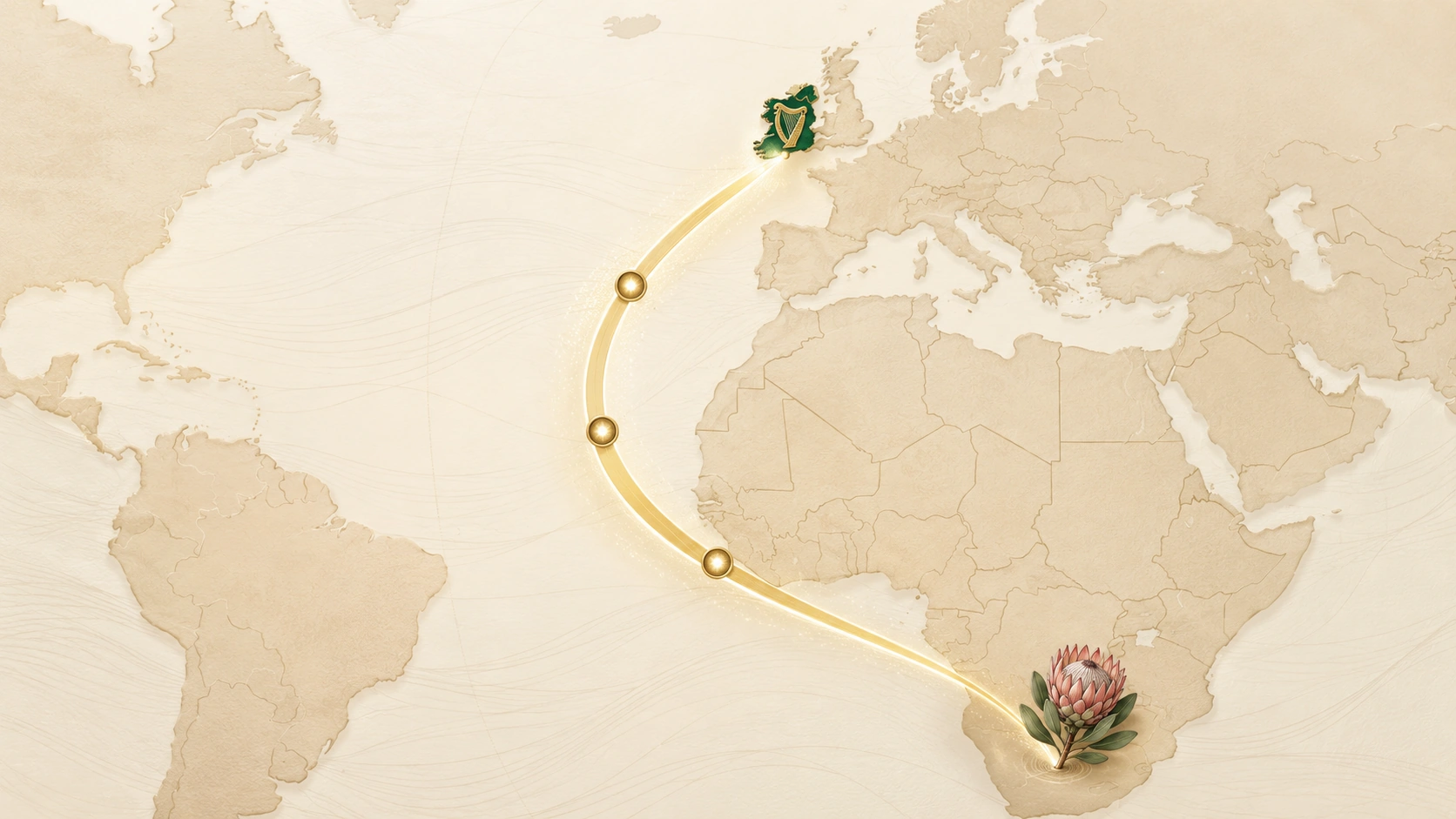
The process mirrors our UK corridor. Your rand moves from your own South African bank account to a settlement account at Capitec, a SARB authorised dealer. Your rate is locked, the conversion to euros happens at that rate, and the payment is sent by SWIFT to your Irish account. In our experience on this corridor, payments settled today generally show in the Irish account within 24 hours - Irish banks are well geared for international receipts and we maintain visibility on how your money moves, bank to bank.
One technical point worth knowing: transfers from South Africa arrive by SWIFT, not SEPA. SEPA is the fast payment network between European accounts, and Ireland is a SEPA country - but a payment originating in South Africa travels the SWIFT route regardless. If you are comparing timing expectations with friends transferring within Europe, that is the difference.
Receiving the money in Ireland
Funds can be received into any Irish institution - AIB, Bank of Ireland and PTSB are the accounts we see most often. The receiving account must be in your own name, and on larger amounts your Irish bank may ask about the source of funds. That is a routine check, and the documentation from a properly reported South African transfer answers it cleanly.
What the transfer costs
WBForex charges no service fee. The rate we quote you is all-in: it is the exact rate your money converts at, with nothing added before or after it. You see the live rate and the exact euros that will arrive - lock it in there and then, or wait and ask for a fresh quote when the timing suits you. The only other cost is a flat R350 SWIFT fee charged by the bank for the international payment - the standard charge any SWIFT transfer carries - regardless of the size of the transfer.
On the Irish side, some banks apply a small receiving fee for international payments under their own tariff - it varies by bank and account type, so check your account terms; it is typically modest, but it is theirs, not ours, and we would rather you expect it than be surprised by it.
The documents you will need
First transfers involve a short onboarding: proof of identity and address for FICA verification, and confirmation that the South African account the funds come from and the Irish account they go to are both in your own name. For transfers within your R2 million single discretionary allowance, that is essentially it.
For larger transfers using the foreign investment allowance, add the SARS side: an approved AIT, evidenced by the TCS PIN SARS issues when an AIT is approved, plus the source-of-funds documentation SARS reviewed. It sounds like a stack; in practice, clients who have their tax affairs in order gather it in a sitting, and we tell you exactly what is needed for your situation before anything starts.
The situations we see on this corridor
Most of the South Africans we help with euro transfers fall into a handful of patterns. Some are relocating for work in Dublin or Cork and settling in Ireland for good - preparing with our moving-to-Ireland money checklist and transferring savings across in stages as the SDA allows. Some are funding a property purchase and need a larger, AIT-approved transfer to land on a completion date. Some are supporting family or funding studies with smaller, recurring transfers. And some are on a longer road: building a life in Ireland with an eye on Irish citizenship, which - through the Common Travel Area - carries the right to live and work in the UK as well.
Whatever the pattern, the transfer mechanics are the same; what changes is the planning around allowances and timing, and that is the conversation we have before anything moves. For more general details on our international corridor operations, see our money transfers service.
Frequently Asked Questions
Can I use my single discretionary allowance to send money to Ireland?
How does money from South Africa arrive in an Irish bank account?
Do I need SARS approval to transfer money to Ireland?
Every corporate trade contributes to our goal of carbon neutrality
Through the WhiteBIRCH Foundation, WBForex has planted 428 trees in the Scottish Highlands rewilding grove. We move your capital while protecting the planet — because ethical leadership in the SA–UK corridor means more than just competitive rates.
View our grove on Trees for LifeLast reviewed: July 16, 2026