The ZAR to EUR corridor
Transfers from South Africa to the Netherlands run bank to bank over the SWIFT network into your Dutch IBAN, converted from rand at bank-beating rates with a flat R350 SWIFT fee per transfer, irrespective of the amount - no percentage fees, no margin hidden inside a "free" transfer. These are the same euro rails we run daily into Ireland, so the Dutch corridor starts life operationally proven rather than experimental. Among Dutch banks, ING, Rabobank and ABN AMRO are the majors our clients use; many new arrivals start with the digital provider bunq to get an account open quickly, then move to one of the majors once settled - more on the sequencing below.
Your annual allowances work identically from the Netherlands. The Single Discretionary Allowance lets you move up to R2 million per calendar year with no prior SARS approval - doubled from R1 million in the 2026 Budget announced on 25 February 2026 - and the Foreign Investment Allowance covers a further R10 million per calendar year with a SARS Approval for International Transfer (AIT). Both are per adult, so a couple can move R4 million per calendar year under the SDA alone. Above the combined R12 million ceiling, a SARS Letter of Compliance and a SARB FinSurv application apply. Learn more in our annual allowances guide.
The BSN comes first
The single most useful thing to know before your first Dutch transfer: full accounts at the major Dutch banks generally require your BSN - the citizen service number you receive when you register with your municipality - along with proof of a Dutch address. That makes your registration appointment, not your bank appointment, the true start of your Dutch banking life. It is a different rhythm from the corridor most South Africans know: in the UK the bank account usually comes first and the admin follows, whereas the Dutch sequence runs registration, then number, then bank - and families who arrive expecting the British order lose their first fortnight to it. Many arrivals bridge the gap with a bunq account opened quickly on arrival, receive their first transfer there, and open with ING, Rabobank or ABN AMRO once the BSN and address are in place. Whichever route you take, have the receiving account fully operational before your money is ready to move - an account stuck in verification is the most common avoidable delay we see on any corridor.
Ceasing SA tax residency from the Netherlands
Cessation of SA tax residency is a SARS process and runs identically from Amsterdam, Rotterdam or Eindhoven: the ordinarily resident test, the physical presence test where needed, the deemed-disposal CGT event on cessation, and SARS's non-resident confirmation at the end - with backdating to your permanent departure available where the facts support it. Until you file, SARS's records show you as a tax resident with worldwide income in scope, and your retirement annuity clock has not started. South Africa and the Netherlands have a double taxation agreement governing SA-sourced income after cessation; how it applies to your income is confirmed by the SARS-registered tax practitioner who carries out the tax work. Read more in our tax emigration services.
One pattern specific to this corridor: arrivals in the Netherlands are often focused - understandably - on the Dutch side of their tax affairs, including the special expat facility commonly known as the 30% ruling, whose rules and rates have been revised repeatedly in recent years and belong with a Dutch adviser. In that focus, the South African side gets forgotten. The two are separate systems: nothing you arrange with the Dutch tax authority changes what SARS's records say about you.
Unlocking your South African retirement annuity from the Netherlands
The rules are set by SARS, not by where you live: after SARS formally recognises your cessation of tax residency, a three-year waiting period applies before early encashment of a retirement annuity, with the clock running from SARS's confirmation date - not from the day you landed at Schiphol. On withdrawal, a SARS tax directive (typically 10 to 21 working days) must issue before the fund administrator releases anything, and lump sum tax is deducted at source - the first R27,500 tax-free on a lifetime cumulative basis, then 18%, 27% and 36% bands. What arrives in your Dutch account is the net amount in euros, converted at bank-beating rates with the same flat R350 SWIFT fee. Preservation funds carry a one-withdrawal entitlement that can unlock part of your money without the three-year wait, and living annuity capital cannot be encashed at all - only the income drawdown can move - so establishing exactly what you hold is the first step in any timeline we quote. Read more in our access your RA guide.
How the process actually runs, step by step
For straightforward savings or inheritance transfers, steps 2 to 4 simplify into the allowance or AIT process and the timeline shortens accordingly.
What it costs and how long it takes
Transfers: bank-beating rates and the flat R350 SWIFT fee per transfer - the entire transfer cost from us, with no percentage taken anywhere in the chain we control. Cessation and retirement annuity work: a fixed fee, quoted upfront and confirmed before any work begins, with the tax work carried out by a SARS-registered tax practitioner.
On time: the transfer leg runs to a two-business-day value date for most spot transfers once compliance is complete; the SA side sets the real timeline. AIT approval depends on your tax compliance and source-of-funds documentation. The tax directive takes 10 to 21 working days. The three-year rule is statutory and cannot be shortened - so filing your cessation now, rather than when you eventually want the money, is the highest-value move available, because every month of delay adds a month to the far end of the clock. One alignment in your favour: the Dutch tax year is the calendar year, the same cycle on which your SDA and FIA reset, leaving only the South African tax year (1 March to end February) out of step - which the SARS-registered tax practitioner reconciles.
Receiving a South African inheritance in the Netherlands
The SA side controls the timeline: the estate winds up under the Master of the High Court - typically 12 to 24 months for a straightforward testate estate - funds pay into a South African account in your name, and the transfer out runs under your allowances or, after cessation of SA tax residency, the AIT process. Once the Master-approved Liquidation and Distribution Account is in place and estate duty settled, we typically complete the offshore leg within a few working days, working directly with your executor throughout. Whether any Dutch tax consequence attaches to the receipt is a question for a Dutch adviser; the South African side is ours. Read more in our inheritance transfers guide.
From Ireland to the Netherlands: how we build a corridor
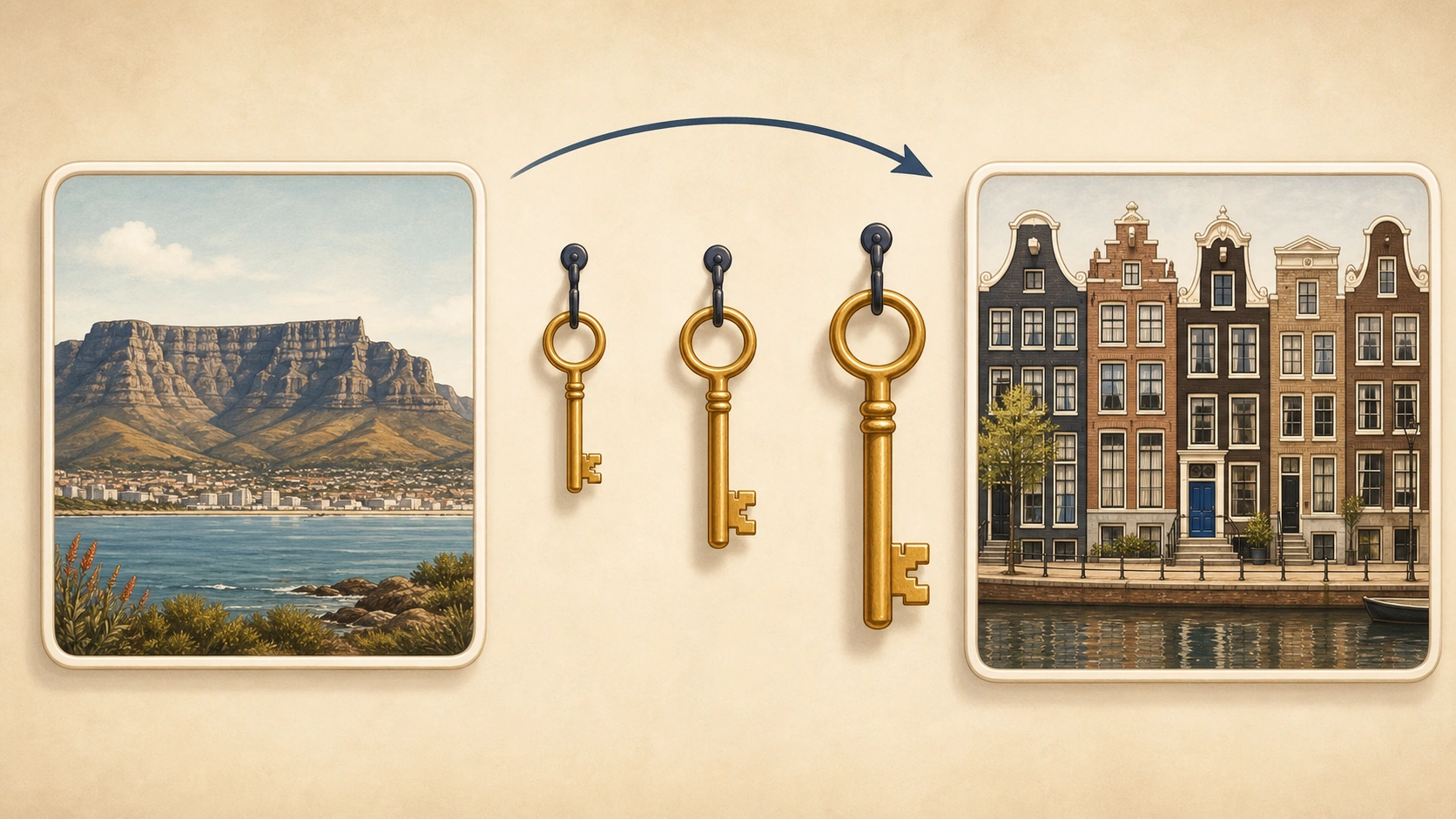
We opened our Ireland corridor in 2026 the same way we are opening this one: not with a brochure, but with an operation already running. By the time the Ireland pages went live, transfers were arriving into AIB, Bank of Ireland and PTSB accounts as a matter of routine, and the corridor content simply described what was already happening. The Netherlands follows the identical pattern. The euro settlement rails are the same rails we use for our South Africa to Ireland transfer service; the SA-side machinery - SARS, allowances, AIT applications, estate coordination - is the same machinery that has served over 5,000 clients since 2018; and the Dutch layer added here is the practical local knowledge our EU clients have taught us: the BSN sequencing, the bridge-account pattern, the receiving banks that actually appear in our book. A corridor page from us is a description of live operations, not an aspiration - and that difference is exactly what you want from the firm holding your transfer.
Common mistakes we see on the Dutch corridor
Sending money the other way
The corridor runs in both directions. Many of our European clients also send rand home - supporting parents, covering a property expense, meeting a family commitment in South Africa. Transfers into South Africa arrive using the recipient's branch code and account number (South African accounts do not use IBANs), with the same bank-to-bank SWIFT security and transparent pricing. Every transfer into or out of South Africa carries a Balance of Payments (BOP) code describing its purpose, and we handle that reporting on every transfer we process.
Why South Africans in the Netherlands use WBForex
- The euro rails are already proven - we run EUR transfers into the EU daily through our Ireland operation
- Specialist in the South African side - SARS, SARB, allowances, estates - since 2018, with 5,000+ clients served
- 6-Time Award Winner, 175 verified Google reviews, and a 69,000+ member SA expat community
- Named people, not a bot: your transfers handled by a dedicated team who answer on WhatsApp
- Flat R350 SWIFT fee per transfer, bank-beating rates, and fixed fees for tax residency work, quoted upfront and confirmed before any work begins
Frequently Asked Questions
How much money can I transfer from South Africa to the Netherlands per year?
Can I receive a transfer before I have a BSN?
Can I cash in my South African retirement annuity while living in the Netherlands?
Does the 30% ruling affect my South African tax position?
Which Dutch bank should receive my transfer?
Can everything be done remotely from the Netherlands?
Can WBForex handle recurring monthly transfers to the Netherlands?
Every corporate trade contributes to our goal of carbon neutrality
Through the WhiteBIRCH Foundation, WBForex has planted 428 trees in the Scottish Highlands rewilding grove. We move your capital while protecting the planet — because ethical leadership in the SA–UK corridor means more than just competitive rates.
View our grove on Trees for LifeLast reviewed: July 17, 2026